Your Cart is Empty

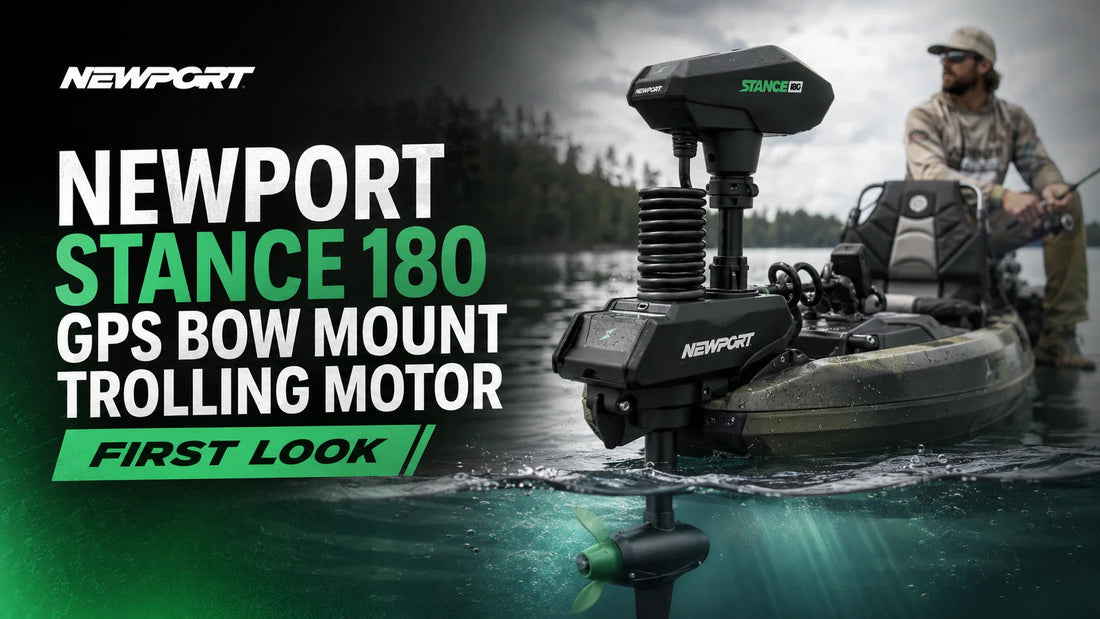
Kayak anglers have been asking for this motor for years. GPS bow-mount trolling motors can transform how an angler holds position, works a shoreline and fishes in wind or current—but most existing systems were originally designed around larger boats. That often leaves kayak owners adapting a long, heavy bow mount to a platform where every pound and every inch of deck space matters.
The new Newport Stance 180 GPS bow-mount trolling motor is Newport’s answer. Unveiled as a kayak-first system, the Stance 180 combines a compact mounting footprint, 65 pounds of thrust, 24V or 36V operation, a 36-inch shaft, GPS anchor-lock and a published motor weight of just 20.5 pounds.
Tiny Boat Nation got an early look at the Stance 180 at ICAST, and we plan to carry it when Newport opens the product for sale. Final pricing, release timing, package contents and detailed compatibility information have not yet been announced. For now, here is everything confirmed—and everything we still want to know.
| Product | Newport Stance 180 GPS bow-mount trolling motor |
|---|---|
| Intended platform | Purpose-built for fishing kayaks |
| Thrust | 65 lb |
| Operating voltage | 24V or 36V |
| Published weight | 20.5 lb |
| Shaft length | 36 inches |
| GPS positioning | Advanced GPS anchor-lock |
| Control | Floating wireless remote and dynamic steering |
| Deployment | Single-hand stow and deploy from a seated position |
| Motor technology | Brushless field-oriented-control motor |
| Water use | Freshwater and saltwater |
| Price and release date | Not yet announced |
These are preview specifications published by Newport and may be updated before the final retail release.
The biggest story is not simply that Newport made another GPS trolling motor. It is that Newport says the Stance 180 was designed from the beginning around a seated kayak angler instead of being reduced from a conventional bass-boat platform.
That design philosophy appears throughout the preview:
The ICAST reel reinforces the same point. The presenter describes the Stance 180 as a bow mount built specifically for kayaks rather than a standard boat motor that was later adapted for one. That distinction matters because a fishing kayak has very different weight, balance, storage and reach constraints than a bass boat.

Newport lists the Stance 180 at 65 pounds of thrust and only 20.5 pounds of motor weight. Thrust alone does not tell us top speed, and Newport has not yet released performance charts, amperage data or recommended maximum kayak weight. Still, the combination is notable.
For kayak anglers, the purpose of a bow mount is usually not maximum speed. The real value is controlled low-speed movement and the ability to keep the bow where the angler wants it while wind, current and waves try to move the boat. A high-output, responsive motor can make those corrections without operating at its maximum setting all day.
The low published weight may be just as important as the thrust rating. Weight added at the bow can affect trim, steering and how easily a kayak can be launched, transported or loaded onto a trailer. A lighter motor also places less static load on the bow mounting area. Actual installation requirements will still depend on the kayak, mounting plate and hull reinforcement.
Newport says the Stance 180 includes advanced GPS anchor-lock. Once engaged, the motor can automatically make steering and power corrections to maintain the kayak’s position as wind or current changes.
This is the feature that can turn a bow motor from simple propulsion into a fishing tool. GPS positioning can help an angler:
Some shoppers casually call every GPS-hold feature “Spot-Lock,” but Spot-Lock is Minn Kota’s product name. Newport’s official terminology for the Stance 180 feature is GPS anchor-lock.
The preview page does not yet explain whether the GPS suite will include heading hold, route recording, jog adjustments, cruise control or app connectivity. Those are important questions to revisit when Newport publishes the full manual.

One of the most promising details is Newport’s emphasis on seated operation. The company says the Stance 180 provides single-hand stow and deploy and is designed to operate entirely from the kayak seat.
That solves a real problem. Reaching a conventional bow mount may require an angler to lean far forward, crawl toward the bow or create a custom deployment line. On a narrow kayak—especially in waves or current—that can be inconvenient and potentially unstable.
The ICAST prototype is shown folding horizontally along the bow when stowed. Newport has not yet released a complete demonstration of the production mechanism, but both the official page and the reel emphasize that the final design is meant to let the angler raise or deploy the motor without moving to the front of the kayak.
The Stance 180 is listed as compatible with both 24V and 36V systems. This could be especially valuable for Newport customers who already own a battery system for an NK180 Pro or NK300 stern motor.
The ICAST reel specifically highlights the possibility of using the new bow mount within existing 24V or 36V Newport setups. However, Newport has not yet published the approved batteries, connector requirements, amperage draw, circuit-breaker size or whether any adapter harness is required. Existing owners should wait for the final wiring guide before assuming their current battery can connect directly.
Dual-voltage capability also raises an important question: does the Stance 180 deliver identical thrust and efficiency at both voltages, or does performance change between 24V and 36V? Newport’s current preview does not answer that yet.
Newport identifies the Stance 180 as a brushless motor using field-oriented control, or FOC. In practical terms, FOC is used to manage a brushless motor smoothly and efficiently across changing speeds and loads.
For fishing, that should support quiet operation, progressive power delivery and fast steering corrections without the abrupt feel of a simple stepped-speed motor. Newport describes the system as smooth, efficient and responsive in wind, current and changing conditions. Real-world noise, power consumption and runtime will need to be evaluated once production units are available.
Control is handled through a floating wireless remote. Newport also references “intuitive dynamic steering,” although the company has not yet published a complete explanation of the steering modes or remote functions.
A wireless remote makes sense for a kayak-first motor because it allows the angler to control direction, speed and GPS functions from the seat without dedicating cockpit space to a full-size pedal. The word “floating” is also meaningful on a kayak, where anything dropped overboard needs to survive long enough to be recovered.
We still want to see the production remote’s button layout, battery type, range, pairing process and whether a second remote or phone application can be used as a backup.
Newport states that the Stance 180 is built for both freshwater and saltwater. The preview also mentions an impact-resistant shaft, rugged waterproof components and a design intended for weeds and moving water.
The lower unit displayed at ICAST uses a bright green two-blade propeller and a skeg beneath the motor housing. The full production specifications have not yet disclosed the shaft material, waterproof rating, sacrificial-anode arrangement, recommended saltwater maintenance or replacement-propeller options.
Saltwater anglers should still expect to rinse the motor and mounting hardware with fresh water after use and follow Newport’s final maintenance instructions.

Newport describes the motor as having a compact universal footprint, but “universal” should not be interpreted as a guarantee that it bolts directly onto every kayak.
A suitable installation will likely depend on:
The ICAST display shows the motor installed on a large fishing kayak with a dedicated bow mounting area. Tiny Boat Nation will publish model-specific fitment guidance once Newport releases the mounting pattern and production installation manual.
The Stance 180 does not replace the purpose of Newport’s stern-mounted NK motors. The two layouts solve different problems.
A stern motor is generally positioned well for efficient forward propulsion and can leave the bow open. A GPS bow mount is primarily valuable because it can pull and steer the bow while automatically holding or controlling fishing position.
Some anglers may eventually use a stern motor for covering distance and the Stance 180 for precise fishing control. Others may choose the Stance 180 as their primary motor because GPS anchor-lock matters more than maximum travel efficiency. Final battery requirements, total installed weight and registration rules will influence which setup makes the most sense.
The official preview gives us more information than a typical teaser, but several purchasing details remain unknown:
Until those details are published, any price, runtime, range or compatibility estimate should be treated as speculation.
The Stance 180 looks like one of Newport’s most important kayak products to date. Its headline specifications are competitive, but the strongest part of the concept is the design brief: build the motor around the kayak angler rather than asking the kayak angler to adapt around the motor.
The 20.5-pound weight, 36-inch shaft, dual-voltage capability, seated deployment and GPS anchor-lock directly address the compromises that have made conventional bow mounts difficult to install on kayaks.
The big questions now are price, GPS performance, real-world power consumption, mounting compatibility and how refined the production stow/deploy system will be. Those details will determine whether the Stance 180 becomes a niche option or one of the default GPS bow mounts for serious kayak fishing.
It is a compact GPS bow-mount trolling motor that Newport says was designed from the ground up for kayak anglers.
Newport lists the motor at 65 pounds of thrust.
The published preview weight is 20.5 pounds. Newport has not clarified whether that figure includes every mounting component and accessory in the final package.
It has Newport’s advanced GPS anchor-lock system. “Spot-Lock” is Minn Kota’s branded name for its own GPS positioning feature.
Newport lists the Stance 180 as a 24V/36V motor. Final battery, wiring and circuit-protection requirements have not yet been published.
The ICAST preview suggests existing Newport 24V or 36V owners may be able to use related battery systems, but direct compatibility and required connectors must be confirmed in Newport’s production documentation.
Yes. Newport’s preview explicitly states that the Stance 180 is designed for freshwater and saltwater use.
The preview specification is a 36-inch kayak shaft.
Newport says the final design will support single-hand stow and deploy while the angler remains seated.
No universal fit should be assumed. The kayak must have a suitable bow mounting area, sufficient structure, stow clearance and safe battery-cable routing.
Newport has not published speed testing. Speed will vary with the hull, load, water conditions, battery voltage, propeller and installation.
No runtime data has been announced. Runtime will depend on voltage, battery capacity, speed, wind, current and how often GPS anchor-lock must make corrections.
Newport has not announced MSRP or dealer pricing. Aiming for $1,999 MSRP
The official preview page is currently accepting launch signups, but it does not list a confirmed retail release date.
Tiny Boat Nation plans to carry the Newport Stance 180 when it becomes available. We will update this first-look guide as Newport releases pricing, production specifications, compatibility information and preorder details.
Join the Tiny Boat Nation email or SMS list to be notified when the product page, launch date and ordering information become available.