Your Cart is Empty

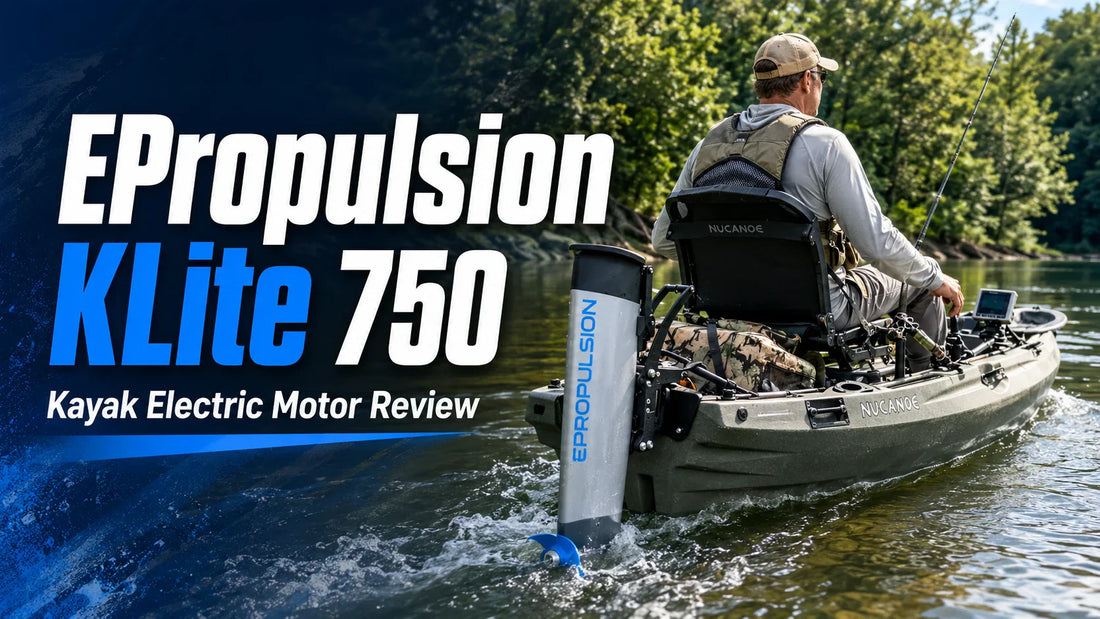
The ePropulsion kLite 750 may be the closest thing yet to a true “throw-and-go” electric outboard built specifically for fishing kayaks. It combines the motor and a 378Wh battery into a 14.3-pound unit, operates in approximately seven inches of water, and gives anglers three distinctly different ways to control power: Fish, Go and Sport modes.
That specification list is already compelling. What makes this launch more interesting is how much direct kayak-angler feedback appears to have shaped the final product. In a detailed prototype walkthrough, the motor’s field tester explains that he worked through multiple motor and mount revisions with ePropulsion engineers, tested it in skinny gravel-bottom rivers and strong current, and specifically pushed for features such as Fish Mode and the adjustable Soft-Lock reverse system.
Tiny Boat Nation now has the ePropulsion kLite 750 available for preorder at a current listed price of $1,599. The first production availability is expected in August 2026, although final fulfillment timing remains subject to manufacturer availability.
The kLite 750 is a purpose-built stern-mounted electric outboard for recreational and fishing kayaks. Unlike a conventional trolling motor installation, the main motor housing contains its own 378Wh lithium-ion battery. That removes the need to carry a separate battery box for shorter trips and reduces the cable runs and deck clutter associated with adapting a boat-oriented trolling motor to a kayak.
The motor produces up to 500 watts continuously in Go Mode and can temporarily reach 750 watts in Sport Mode. Its lower unit can be raised for very shallow operation, while the integrated rudder-shaped housing continues to influence steering even when the throttle is neutral.

| Motor type | Purpose-built kayak electric outboard |
|---|---|
| Nominal power | 500W continuous |
| Maximum power | 750W in Sport Mode |
| Reverse power | Up to 300W with Soft-Lock reverse |
| Integrated battery | 378Wh, 25.2V lithium-ion |
| Motor and battery weight | 14.3 lb |
| Motor-mount weight | 5.1 lb |
| Total system weight | Approximately 19.4 lb |
| Minimum operating depth | Approximately 7 inches |
| Shaft-height adjustment | 10.9 inches |
| Charging time | Approximately 4 hours with included charger |
| Water protection | IP67 motor and battery |
| Water use | Freshwater and saltwater |
| Mounting pattern | Standard four-bolt stern pattern |
| Warranty | Two-year limited manufacturer warranty |
Specifications are based on ePropulsion’s current product information and may be updated as production units reach dealers.
Many kayak motor systems begin with hardware designed for a jon boat, bass boat or transom. The angler then has to solve the battery location, cable routing, steering, deployment and weight-distribution problems.
The kLite 750 reverses that approach. Its integrated battery, kayak-specific mount, compact throttle, separate display and adjustable steering bar were designed as one system. That does not mean every kayak will accept it without an adapter, but it means the product starts with kayak limitations in mind.
| Design question | Typical adapted trolling motor | kLite 750 approach |
|---|---|---|
| Battery | Separate battery and box | Integrated 378Wh battery |
| Basic trip setup | Battery, motor and wiring installed separately | Motor and battery carried as one 14.3-lb unit |
| Low-speed control | Depends on throttle design | Dedicated adjustable Fish Mode |
| Display | Often integrated near the throttle or not included | Separate sun-shaded color display |
| Shallow-water focus | Varies by shaft and installation | Designed to operate at approximately 7 inches |
| Range extension | Motor normally runs directly from external battery | Optional 12V source recharges the integrated battery |
The motor and built-in battery weigh 14.3 pounds together. Add the 5.1-pound mounting assembly and the complete published system weight is approximately 19.4 pounds.
That matters for more than carrying the motor from the truck. Weight at the stern changes how a kayak trims, how much water sits around the scuppers and how easily the hull can be dragged or carted. A lighter propulsion unit can also make it more practical to remove the motor between trips instead of leaving a permanent, heavy installation on the boat.
For a quick evening session, the basic concept is simple: charge the integrated battery, click the motor into the mount, connect the controls and launch. For longer trips, the optional range-extension accessory adds another path without forcing every owner to carry a large external battery on every outing.

ePropulsion publishes a minimum operating depth of approximately seven inches. The prototype tester also demonstrates the motor working through extremely shallow gravel-bottom water and describes seven-inch access as one of his favorite features.
That shallow draft can matter in:
The shaft position is adjustable through a 10.9-inch range, so the motor can be raised for skinny water and lowered when deeper placement is needed in chop or heavier current. Shallow-water capability does not make the propeller indestructible. Owners should still inspect the propeller and shear pin after repeated contact with rocks, gravel or submerged timber.
Fish Mode is likely the feature that will matter most once the novelty of the integrated battery wears off. Instead of forcing the throttle’s full travel to control zero through 500 watts, Fish Mode limits the upper output so the same throttle movement controls a much narrower power range.
The official product information describes Fish Mode as approximately 0–200 watts. In the prototype walkthrough, the tester demonstrates selectable maximum settings—including examples around 100, 200 and 300 watts—and explains why he requested the feature. When fishing into changing wind or current, a tiny throttle movement on a high-output motor can accelerate the kayak farther than intended. Mapping the throttle across a lower maximum output gives the angler finer control and reduces abrupt prop wash around nearby fish.
Go Mode provides up to 500 watts continuously. This is the normal cruising mode for moving between fishing areas, crossing open sections and maintaining progress into current or headwind.
On a Crescent Kayaks Lite Tackle 2, both ePropulsion’s test table and the prototype tester’s demonstration show approximately 5.5 mph at 500 watts. That is test data from one hull and should not be treated as a guaranteed speed for every kayak.
Sport Mode raises output to 750 watts for a temporary burst. The tester demonstrates activating it with a double tap and reports approximately 6 mph on the Crescent Lite Tackle 2.
Sport Mode is intended for situations such as pushing into a strong headwind, moving through faster current or briefly increasing speed. It is only available when the integrated battery is above 50% charge and operating within its normal temperature range. It is not a continuous all-day cruising mode.
The kLite 750 separates the digital display from the throttle body. The throttle remains low beside the seat, reducing the chance that clothing, a PFD strap or fishing line catches on a tall control. The sun-shaded display can be positioned on a track, deck or console where it is easier to see.
The display presents the information that matters most while underway:
The prototype tester also shows menu controls for display brightness, software information, Fish Mode settings and a silent setting that reduces unnecessary audible prompts.
The motor mount uses a standard four-bolt stern pattern found on many fishing kayaks, motor plates and shallow-water-anchor locations. The motor locks onto a mounting pin and can be removed by releasing the mount and lifting the motor straight up.
The mount includes several thoughtful kayak-specific details:
The standard four-bolt pattern does not guarantee universal fit. Some kayaks can use factory points, while others will need an adapter plate, internal backing or a custom bracket. Owners should verify stern structure, access and weight capacity before ordering.
Stern-mounted kayak motors often want to tilt upward when reverse thrust is applied. A rigid lock can stop that movement, but a fully locked motor creates another problem if the lower unit strikes a log, rock or oyster bed while traveling forward.
The kLite 750 uses a spring-tensioned Soft-Lock mechanism. It can hold the lower unit in the water while producing up to 300 watts in reverse, but it still allows the motor to kick up when it encounters a substantial forward obstacle.
In the prototype demonstration, the tester progresses from low reverse power to the full 300-watt reverse setting without the motor climbing out of the water. He presents it as a practical tool for slowing a drift, backing away from cover and holding longer on productive river targets.

Runtime changes dramatically with power. At low wattage, a 378Wh battery can operate for many hours. At 500 watts, the same battery is being discharged much more quickly. The following data was published by ePropulsion after testing on a Crescent Kayaks Lite Tackle 2.
| Power | Approx. speed | Integrated-battery runtime | Integrated-battery range | Extended-system runtime* | Extended-system range* |
|---|---|---|---|---|---|
| 19W | 2 mph | 19 hr 54 min | 40 miles | 56 hours | 113 miles |
| 133W | 4 mph | 2 hr 48 min | 11 miles | 8 hours | 32 miles |
| 500W | 5.5 mph | 48 minutes | 4 miles | 2 hours | 11 miles |
| 750W Sport Mode | 6 mph | 15 minutes | 1.5 miles | 1 hr 24 min | 8 miles |
*Extended figures use the integrated 378Wh battery plus the optional range-extension setup with a 54Ah, 691Wh third-party battery, for 1,069Wh total energy. These are manufacturer test results on one kayak, not universal guarantees.
Hull efficiency, total load, propeller depth, current, wind, water conditions and operating style can change actual performance substantially.
The kLite 750 does not run directly from a third-party battery. Its integrated battery always powers the motor. The optional eLite/kLite Range Extension Kit allows a compatible 12V battery to recharge the internal battery at up to 100 watts while the system is in use.
This distinction is important. The external battery acts as an energy source for charging—not as a direct motor battery.
In the creator’s field test, he paired the system with a 12V 54Ah Dakota Lithium battery rated at 691Wh. He reports completing a roughly 12-hour day involving long distances and high river flow without exhausting the combination. That is a useful real-world observation from one configuration, but it is not a promise that every angler will receive 12 hours of operation. Higher sustained wattage, a less efficient hull or stronger current will shorten runtime.
The long-form walkthrough provides unusual visibility into the development process. The tester says he began working with ePropulsion prototypes in late 2025 and evaluated four motor or mount iterations. He describes repeatedly returning feedback about throttle response, mount geometry, reverse behavior and durability, with the engineering team revising hardware and software between tests.
Several of the final product’s most fishing-specific features appear connected to that process:
That does not replace independent long-term testing of production motors, but it is encouraging to see the product tested as a fishing tool rather than only on a laboratory stand.
ePropulsion currently lists the following equipment in the standard package:
Optional accessories include the foot-control steering kit, throttle mounting plate, spare propeller and eLite/kLite Range Extension Kit. Do not assume that a third-party 12V battery is included.
The kLite 750 is especially compelling for anglers who:
It may be less suitable for someone who needs to cruise at maximum output all day, owns a kayak without a practical stern mounting solution or wants a bow-mounted GPS positioning motor. The kLite 750 is a compact electric outboard, not an anchor-lock trolling motor.
The motor and integrated battery weigh 14.3 pounds. The mount adds 5.1 pounds, for a total system weight of approximately 19.4 pounds.
ePropulsion testing on a Crescent Lite Tackle 2 shows approximately 5.5 mph at 500 watts and 6 mph in temporary 750-watt Sport Mode. Speed varies by kayak, load and conditions.
ePropulsion rates the motor for operation in approximately seven inches of water, and the prototype tester demonstrates it in very shallow gravel-bottom river conditions. Operators should still avoid repeated propeller strikes.
The 378Wh battery is integrated into the motor housing and is not removed as a separate battery pack.
Not directly. A compatible 12V battery can recharge the integrated battery through the optional eLite/kLite Range Extension Kit.
The integrated battery takes approximately four hours to charge from empty with the included charger.
Fish Mode narrows the throttle’s power range for more precise low-speed movement. It helps anglers make small corrections without an abrupt increase in prop wash.
Yes. The Soft-Lock system provides up to 300 watts of reverse power while helping keep the propeller in the water.
It uses a common four-bolt stern pattern, but fit is not universal. Some kayaks need an adapter plate, reinforcement or custom bracket.
Yes. The motor and battery are IP67-rated for freshwater and saltwater. Rinse the system with fresh water after saltwater use.
ePropulsion announced August 2026 availability. The prototype tester described the first batch as arriving in early August, but exact dealer fulfillment dates may change.
Tiny Boat Nation currently lists the kLite 750 preorder price at $1,599. Pricing is subject to change.
The ePropulsion kLite 750 is not simply interesting because it is light or because it can briefly produce 750 watts. Its strongest advantage is that the entire system appears to have been organized around actual kayak-fishing problems: shallow draft, precise low-speed control, seated access, removable installation, reverse behavior and optional range extension.
The integrated battery makes short trips genuinely simple, while the range-extension accessory gives serious river and all-day anglers a path to more energy without changing how the motor itself operates. Fish Mode and Soft-Lock reverse are the features most likely to distinguish the kLite 750 after the initial launch excitement fades.
Preorder the ePropulsion kLite 750 from Tiny Boat Nation, or contact the TBN team before ordering if you need help evaluating stern fitment, steering or range-extension options.