Your Cart is Empty

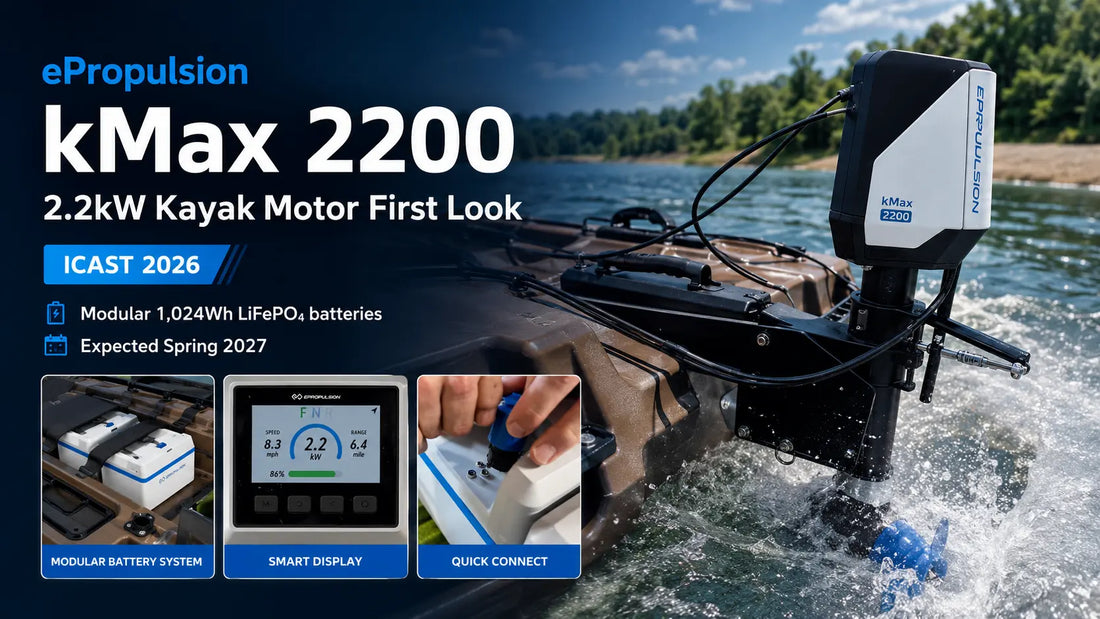
The ePropulsion kMax 2200 is not being positioned as another lightweight motor for minimalist kayaks. This is ePropulsion’s high-output answer for bigger fishing platforms: 2.2kW of electric power, a modular 48V battery system and the ability to scale from one portable 1,024Wh pack to more than 4kWh of onboard energy.
The first public demonstrations at ICAST 2026 immediately drew attention because the prototype was not merely idling around a display pond. In an on-water test aboard a large Bonafide XTR fishing kayak, the digital display reached 2,200 watts and approximately 7.8 mph. Another early preview frame showed 8.3 mph on the motor display. Those are impressive observations, but they are not yet official production speed guarantees.
ePropulsion has now published the final specifications for the accompanying kMax 48V battery, giving us a much clearer picture of the system. The motor itself is still in the preview stage, with pricing, weight, final compatibility and package contents yet to be released. Here is everything Tiny Boat Nation knows so far.
The kMax 2200 is an upcoming stern-mounted electric propulsion system developed for larger fishing kayaks and small craft. Its visible model name corresponds to its demonstrated maximum output: 2,200 watts.
The prototype uses a separate motor, modular LiFePO4 battery and cockpit-mounted controls rather than an integrated battery. That architecture lets an owner choose between a lighter one-battery setup or add as many as four parallel batteries when range matters more than minimum weight.
The early marketing message is simple: “Big Motor. Big Kayaks. Big Range.” That positioning is important. A 2.2kW motor can produce more acceleration and steering force than many narrow or lightly built kayaks are prepared to handle. This system appears intended for wide, stable fishing platforms with appropriate stern structure, steering and battery storage.
| Motor model | ePropulsion kMax 2200 |
|---|---|
| Maximum output demonstrated | 2.2kW / 2,200W |
| Battery class | 48V system; 51.2V nominal battery voltage |
| Battery energy | 1,024Wh per pack |
| Battery chemistry | LiFePO4 / lithium iron phosphate |
| Battery capacity | 20Ah |
| Official battery weight | 24.3 lb / 11 kg |
| Battery dimensions | 13.8 × 7.2 × 7.6 inches |
| Parallel batteries | Up to four |
| Maximum published modular energy | 4,096Wh with four packs |
| Single-battery charge time | As little as two hours |
| Battery waterproof rating | IP67 |
| Battery life | Up to 2,800 cycles at 80% state of health |
| Battery warranty | Two years for non-commercial use |
| Expected availability | Spring 2027 |
The battery specifications above are now published by ePropulsion. Motor specifications beyond the demonstrated 2.2kW output remain subject to final production confirmation.
In the supplied ICAST test video, the kMax 2200 was installed on a Bonafide XTR, a large and substantial fishing kayak. The tester gradually increased power while navigating a crowded demonstration area. The display climbed through the six- and seven-mile-per-hour range before showing approximately 7.7 to 7.8 mph at 2,200 watts.
The tester also said another driver had seen approximately 8.2 mph under different conditions. Separately, an earlier preview reel briefly showed 8.3 mph, 2.2kW, an estimated 6.4-mile range and 86% battery on the display.
These observations prove that the prototype can push a large kayak well beyond normal trolling speed. They do not establish an official top speed or range. Actual results will depend on:
The most defensible statement today is that an ICAST prototype reached about 7.8 mph on a large Bonafide XTR while the display showed full 2.2kW output. It is too early to promise that speed on every compatible kayak.
The on-water tester attributed some of the speed to the relatively compact lower motor pod. His reasoning was that less exposed underwater surface area may reduce drag. That is a plausible observation, but ePropulsion has not yet published hydrodynamic testing or propeller specifications for the motor.
What is visible is a narrow lower unit, protective skeg and blue three-blade propeller. The motor appears much more purpose-built than a conventional trolling-motor lower unit adapted to a high-power system.

Maximum power gets attention, but the prototype’s Fish Mode may be the feature that makes the system practical. During the ICAST test, Fish Mode limited the maximum output to approximately 200 watts. The tester could move the throttle through its full range without unexpectedly releasing all 2,200 watts.
He reported approximately 2.7 mph during part of the Fish Mode demonstration and said he had seen speeds closer to 4 mph under other conditions. Again, those speeds are individual observations rather than final specifications.
The benefit is control. On a heavy fishing kayak, 200 watts can be enough to work a shoreline, correct for wind or move between nearby targets. Mapping the full throttle travel across a smaller power range should make low-speed adjustments more predictable and reduce the risk of an accidental full-power launch.
It is not yet confirmed whether production owners will be able to change the Fish Mode power limit or whether 200 watts will be the fixed maximum.
The prototype uses a compact, rail-mounted throttle with clearly defined forward, neutral and reverse positions. A separate digital display is mounted higher in the angler’s sight line, where it can present power, speed, battery information and estimated range without placing a large screen beside the seat.
The ICAST tester described the throttle as intuitive and said he became comfortable with it quickly. The video also shows a magnetic safety lanyard, an especially important feature on a motor capable of strong acceleration.
Foot-controlled steering on the test kayak produced a tight turning radius. The kayak carved sharply even at higher speeds in the demonstration area, but final steering hardware, steering-bar geometry and compatibility have not yet been published.

The kMax battery is marketed as a 48V pack, while its official rated voltage is 51.2V. That is normal naming for a 16-cell LiFePO4 system. Each battery stores 1,024Wh and has a 20Ah capacity.
At 24.3 pounds, the production specification is slightly heavier than the roughly 23-pound figure shown on a scale in an early reel. The official dimension is 13.8 × 7.2 × 7.6 inches, which is compact enough to fit into many large kayak hatches, beneath elevated seats or inside rear tank wells.
Battery location matters. Placing a pack below deck or beneath the seat can lower the center of gravity compared with stacking weight high on a rear crate. The preview footage shows several configurations, but every installation will need appropriate tie-downs, ventilation clearance and protection from shifting.

The modular system supports up to four batteries connected in parallel:
| Battery count | Total energy | Published battery weight |
|---|---|---|
| 1 | 1,024Wh | 24.3 lb |
| 2 | 2,048Wh | 48.6 lb |
| 3 | 3,072Wh | 72.9 lb |
| 4 | 4,096Wh | 97.2 lb |
Those battery weights do not include the motor, mount, cables, charger or installation hardware. A four-battery system offers substantial energy, but almost 100 pounds of battery must be considered in the kayak’s capacity, trim and transport plan.
This is why the modular design matters. A local trip may call for one pack. A tournament angler covering large water may value two or more. Owners do not have to carry the maximum configuration every time.
ePropulsion combines the positive, negative and communication connections into one integrated cable. The battery connection shown in the preview uses a keyed circular plug, simplifying installation and reducing the number of loose terminals and communication leads.
Each additional parallel battery uses a single cable, and the system manages the connected packs. Fewer separate connections can reduce clutter and potential failure points, although the production manual will determine the exact cable routing, protection and fastening requirements.
The early reel only promised “Super Fast Charging.” ePropulsion has now confirmed that a single kMax battery can recharge from empty to full in as little as two hours with the appropriate charger. The company says even a four-battery configuration can be charged overnight.
The official battery specifications list a continuous maximum charge current of 20A. Final charger package options and whether the fast charger is included with the motor or sold separately are still unknown.
The official battery includes Bluetooth communication with the ePropulsion app. Owners should be able to monitor state of charge, view data, perform software updates and access service diagnostics from a phone or tablet.
Official promotional images also show trip history, speed and power graphs. It remains unclear which app functions come from the battery alone and which require the kMax 2200 motor and final production display.
The battery uses lithium iron phosphate chemistry and is rated for up to 2,800 cycles at 80% state of health when tested at 0.5C charge and discharge rates at 25°C. That is a strong published cycle-life figure for a portable marine battery.
The pack is IP67-rated, meaning the enclosure is designed to resist dust and temporary water immersion under the conditions defined by the rating. That does not mean connectors should be left uncapped or the battery should be stored submerged.
Additional official battery specifications include:
The strongest warning in the ICAST test was also the most responsible: do not assume that every kayak should receive a 2.2kW motor.
High power can expose weaknesses in:
A narrow recreational kayak may become unstable during abrupt acceleration or a sharp high-speed turn. The kMax 2200 is being demonstrated on large, wide fishing platforms for a reason. Buyers should wait for ePropulsion’s final compatibility and installation standards before building a mount or ordering batteries.
The ePropulsion kLite 750 is designed around portability. It combines a 378Wh battery and motor into a 14.3-pound unit, provides 500W continuous power and offers a temporary 750W Sport Mode.
The kMax 2200 takes the opposite approach. It separates the motor and battery, triples the maximum power shown, and uses modular 1,024Wh packs that can scale to four units.
| Feature | kLite 750 | kMax 2200 preview |
|---|---|---|
| Primary goal | Lightweight throw-and-go use | High power and scalable range |
| Power | 500W continuous / 750W Sport | 2,200W demonstrated maximum |
| Battery | Integrated 378Wh | Separate 1,024Wh modular packs |
| Battery expansion | Optional 12V charging extension | Up to four parallel kMax batteries |
| Ideal kayak | Compatible recreational and fishing kayaks | Large, stable, heavily rigged fishing kayaks |
Neither system is universally better. The correct choice depends on whether the owner values minimum weight and easy transport or maximum power and expandable energy.

Despite the newly released battery page, several essential motor details remain unknown:
The official battery page and preview reel both state an expected spring 2027 release. That should be treated as a launch window rather than a guaranteed delivery promise.
The system makes the most sense for anglers using large kayaks as true small fishing boats:
It is likely excessive for a lightweight recreational kayak or anyone whose main priority is carrying the entire propulsion system in one hand.
The kMax 2200 appears to fill a real gap between conventional kayak motors and much larger electric outboards. The ICAST footage shows enough performance to take the system seriously, while the official battery specifications answer many of the range, packaging and durability questions raised by the first reel.
The modular battery may be the most important part of the platform. One 24.3-pound pack keeps the setup manageable. Four packs create more than 4kWh for anglers who value range and can support the additional weight. Two-hour single-pack charging, Bluetooth diagnostics, IP67 protection and a 2,800-cycle rating make the battery more than a prototype prop.
The remaining question is whether the final motor, mount and steering system will be as polished as the battery. Pricing, motor weight, installation standards and production performance tables will determine whether the kMax 2200 becomes a specialized tournament option or the new benchmark for high-power kayak propulsion.
The prototype display showed a maximum output of 2,200 watts, or 2.2kW.
The supplied on-water test reached approximately 7.8 mph on a large Bonafide XTR. Other preview footage showed readings from 8.2 to 8.3 mph, but ePropulsion has not published an official top speed.
The ICAST prototype had a Fish Mode that limited maximum output to approximately 200 watts for more controlled low-speed operation. Final settings have not been announced.
It uses ePropulsion’s new kMax 48V LiFePO4 battery, rated at 1,024Wh, 20Ah and 51.2V nominal.
The official production specification is 24.3 pounds. An early reel showed approximately 23 pounds on a scale, but the published specification should be used.
Each battery measures 13.8 × 7.2 × 7.6 inches.
Up to four batteries can be connected in parallel, providing a maximum published capacity of 4,096Wh.
ePropulsion says a single pack can charge from 0% to 100% in as little as two hours with the appropriate charging equipment.
Yes. The official battery carries an IP67 rating.
ePropulsion rates it for up to 2,800 cycles at 80% state of health under its stated test conditions.
Yes. Bluetooth supports battery state-of-charge monitoring, data, software updates and service diagnostics through the ePropulsion app.
Compatibility has not been published. Based on the power and demonstrations, the system appears intended for larger, stable fishing kayaks with substantial stern structure.
The battery is IP67-rated, but ePropulsion has not yet published the motor’s final saltwater approval or maintenance requirements.
Motor, battery and package pricing have not been announced.
ePropulsion currently states that the kMax motor and battery system are expected in spring 2027. Final dealer and customer-delivery timing may change.
Tiny Boat Nation plans to carry the ePropulsion kMax 2200 when ordering opens. Join the TBN email or SMS list to receive pricing, preorder timing, final specifications, battery options, installation guidance and compatibility updates.