Your Cart is Empty

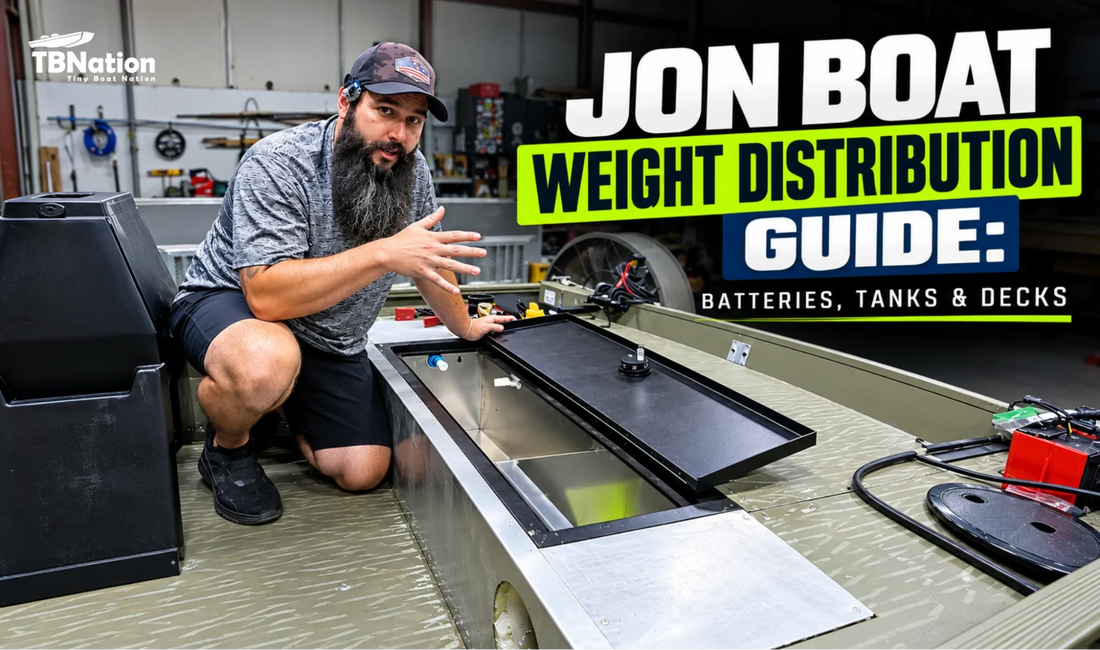
Wondering how to manage your jon boat weight? Proper weight distribution is the difference between a high-performing vessel and an unstable ride. If you want to know how much weight can a jon boat hold, you must first check your hull's official Coast Guard capacity plate.
However, even if you stay well under your jon boat weight limit, placing heavy batteries, fuel tanks, and high decks incorrectly will ruin your boat’s handling. This comprehensive jon boat guide explains how to balance front-to-back cargo, set safe vertical deck heights, and manage shifting liquid weights to ensure you maximize your jon boat weight capacity safely.

To understand weight distribution, we first have to answer:what is a jon boat? A jon boat is a traditional flat-bottomed or modified-V aluminum utility boat designed for shallow water fishing and hunting. Because they are smaller, narrower, and lighter than fiberglass boats, they are highly sensitive to weight placement.
Every single pound added to a small hull changes how it tracks, how it planes, and how stable it feels when you stand up to fish. If you push the boundaries of your jon boat weight limit without balancing the load, the boat can become dangerous to operate or incredibly uncomfortable to fish from.
When planning a jon boat build, the most important principle is your front-to-back (fore and aft) balance. Small aluminum boats operate on a pivot point located roughly in the middle of the hull, often referred to as the midship.

The biggest mistake beginners make in their jon boat builds is trying to mimic large, 20-foot fiberglass bass boats. Large fiberglass boats have massive rear beams designed to carry the outboard, starting battery, trolling batteries, and gas tank all in the back quarter of the hull.

A jon boat is not designed to carry all its weight in the stern. If you place your cranking battery, trolling motor battery, fuel tank, and live well all in the back, the bow will launch into the air when you try to get on plane. Instead, move your heavy batteries and fuel tanks toward the middle or front-quarter of the boat to create an even, balanced ride.

Vertical balance refers to how high you build your casting decks. When looking at different jon boat build ideas, you must factor in the width of your vessel.
Raising your deck moves the boat's center of gravity upward. If you have a wide boat (48 to 54 inches wide or more), the hull will naturally distribute that high weight and remain stable. However, on narrow boats, high decks will make the boat feel incredibly "tippy."

For standard flat-nose jon boats or modified-V hulls, try to keep the new deck height roughly flush with the original factory bench seats.
If you are working with a deeper hull, like a 14ft Deep V Aluminum Boat Kit, you must account for the bow narrowing sharply at the front. The higher and further forward you stand on a V-hull, the more unstable it feels. As a general rule, keeping the deck 4 to 8 inches below the top of the gunnel provides a safe, comfortable center of gravity.

Liquid weight is often overlooked, but it is one of the most dynamic factors affecting your overall jon boat weight capacity.
Water weighs roughly 8 pounds per gallon. If you install a standard 18-gallon aluminum live well, that equates to 144 lbs of shifting weight. When a live well is empty, the boat rides one way; when it is full, it rides completely differently.
Because liquid shifts when the boat turns, you must always center your live well along the middle line of the hull. Never place a live well off to the port or starboard side. Furthermore, if your boat struggles with a high-riding bow, consider moving your live well or fuel tank to the front of the boat to act as a forward ballast, helping to push the nose down when running on plane.
Passenger weight placement is critical, especially when determining something like a 14 ft jon boat weight capacity, where space is tight.
If you typically run your outboard from the rear starboard (right) side of the boat, you are putting a lot of weight in the back corner. To counterbalance this:
Always take your primary fishing partner with you during the testing phase to see exactly how the boat planes with both of your weights inside.

The most vital piece of advice in this jon boat guide is to test your weight distribution on the water before you permanently mount your jon boat accessories or frame your decks.
Take sandbags, dumbbells, or jugs of water that equal the weight of your batteries, fuel, and live well. Move them around the boat on the water until you find the perfect balance that provides a smooth plane and stable fishing platform.
Once you know where your weight needs to sit, you can confidently install structural upgrades like the Gen X 14-15 Jon Boat Kit to finish your dream build.
Proper weight distribution takes time to test, but it guarantees a boat that rides beautifully and keeps you safe on the water. If you need more one-on-one help designing your layout, mapping out your electrical systems, or checking your hull's stability, check out the TBNation Educational Hub for master classes on boat building.
Have questions about which kits or materials will work best for your specific boat? Reach out to our expert team via our Contact Us page, and let's get your dream rig built right!
The exact capacity depends on the length, width, and manufacturer of the hull. Always check the US Coast Guard capacity plate mounted near the transom. This plate dictates the absolute maximum weight (including motor, gear, and passengers) the hull can safely hold.
While it varies by width and manufacturer, a standard 14-foot jon boat typically has a weight capacity ranging from 400 to 600 pounds. This includes the weight of the outboard motor, passengers, batteries, and fishing gear.
No. High casting decks raise your center of gravity, which can be dangerous on narrow hulls (like a 36-inch wide boat). High decks are best reserved for wider boats (48 inches or wider) that can safely displace the top-heavy weight.