Your Cart is Empty

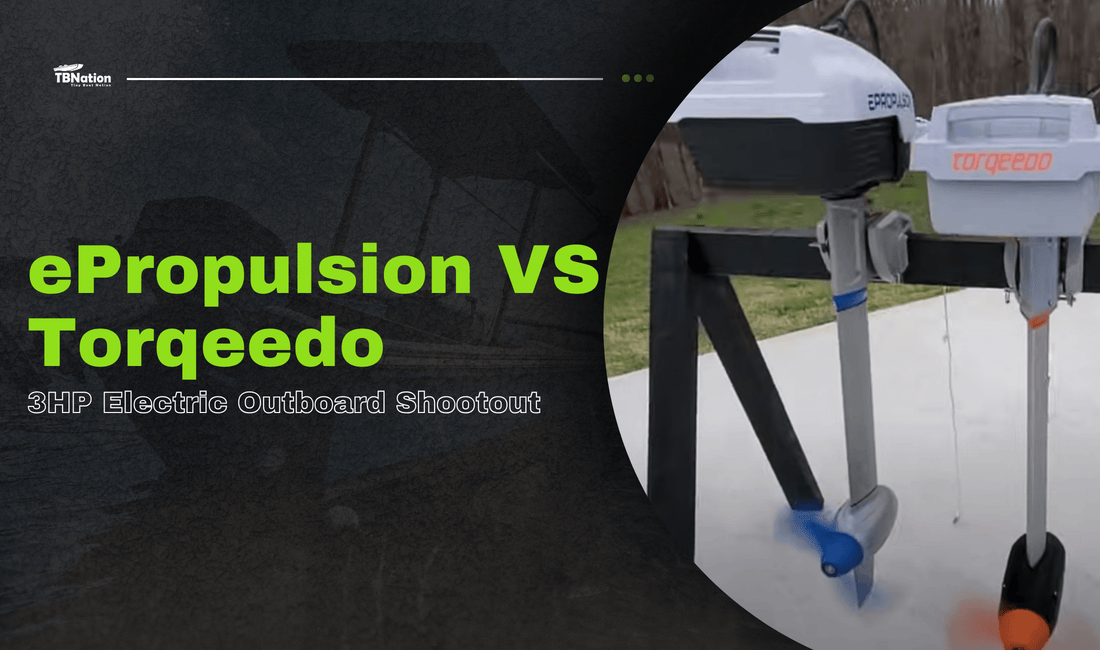
This in-depth comparison explores two of the most popular 3-horsepower electric outboards: the EPropulsion Spirit 1.0 Plus and the Torqeedo Travel 1103C. We'll break down their cost, features, performance, and other key factors to help you make an informed choice. Whether you're a seasoned boater or seeking a dependable upgrade, this head-to-head review highlights what makes ePropulsion Outboard Motors a standout option in the world of electric propulsion.
One of the most pressing concerns for many customers is the expense. The Torqeedo Travel 1103C costs $2,699, whereas the ePropulsion Spirit 1.0 Plus costs $2,001.99, $500 less than its competition. This price difference is significant and may sway the decision of budget-conscious shoppers.

Both outboard motors are considered to have a three-horsepower equivalent, but the Torqeedo Travel 1103C operates at 1.1 kilowatts and 29.6 volts, whereas the ePropulsion Spirit 1.0 Plus runs at 1 kilowatt with a higher voltage of 48 volts.
Another important consideration is the battery's capacity. The Spirit 1.0 Plus has a 40% larger capacity of 1,276 watt-hours than the Travel 1103C, which has a capacity of 915 watt-hours. With a 50% longer runtime, this corresponds to a full-throttle runtime of 50 minutes for the Travel 1103C and 75 minutes for the Spirit 1.0 Plus.
For this test, we used a fully equipped 1436 Grumman Jon boat featuring a floor system, live well, storage compartments, casting deck, and onboard electronics. A key factor to consider when evaluating the performance of these outboard motors is the boat’s substantial weight.

We ran the highest speed test on the same boat, in the same conditions, with both outboards tested consecutively. This guaranteed a fair comparison.
The Torqeedo Travel 1103C had a top speed of 5.9 miles per hour, which was slightly exceeded by the ePropulsion Spirit 1.0 Plus, which reached 6 miles per hour. Despite the minor difference, both outboards are capable perfomers.
The shaft, battery, battery cable, and tiller handle must all be attached as part of the Travel 1103C installation process. Although the procedure is simple, the plastic connectors and alignment problems can make it a little difficult.
The Spirit 1.0 Plus's integrated tiller and communication cables simplify installation. There is no need for a pin because the battery is secured using an inbuilt latch. Overall, the installation process is easier and faster.
The Travel 1103C battery takes around 10.5 hours to charge, but the Spirit 1.0 Plus charges in 8.5 hours, resulting in a shorter turnaround time.
Both versions have solar charging capabilities, with the Travel 1103C supporting up to 50 watts and the Spirit 1.0 Plus up to 180 watts. Furthermore, the Spirit 1.0 Plus battery floats, providing an additional layer of safety.
The Travel 1103C has a display that shows the battery state, current power in watts, remaining range, and speed.
The Spirit 1.0 Plus offers a clear display showing the battery level, real-time power output in watts, voltage, and estimated remaining runtime in minutes, giving users easy access to essential performance information.
The power connectors vary significantly. The Torqeedo features plastic connectors that may be difficult to locate and attach. In contrast, the Spirit 1.0 Plus features stainless steel connectors with a PVD surface treatment, ensuring durability and ease of use.
Both outboards feature brushless, direct-drive motors that require no maintenance and operate with near-silent performance. The Spirit 1.0 Plus, on the other hand, stands out because it can connect to an extra battery, extending the full-throttle runtime to more than four hours.
In conclusion, compared to the Torqeedo Travel 1103C, the ePropulsion Spirit 1.0 Plus offers a number of benefits, such as a longer duration, quicker installation, and extra features like an external battery option and a floating battery. Although both outboards have good performance, the Spirit 1.0 Plus is the obvious victor of this comparison due to its enhancements and cost savings.
The ePropulsion Spirit 1.0 Plus is a great option for anyone searching for an electric outboard that is both reliable and cutting edge. Remember to apply the coupon code found in the video description to receive 5% off your purchase.
We hope that this thorough comparison will assist you in making an informed choice between the Torqeedo Travel 1103C and the ePropulsion Spirit 1.0 Plus. Happy boating!
They’re electric boat motors, no gas, no noise, just clean and quiet power for small boats.
EPropulsion lasts up to 75 minutes at full power. Torqeedo runs for about 50 minutes.
Torqeedo is lighter. But ePropulsion’s battery floats if you drop it in the water, which is handy.
Yes! Both are simple to operate. ePropulsion has fewer components, making it more reliable.
If you want a longer run time, pick ePropulsion. If you want something lighter, Torqeedo is a good choice.